


Tracking stocks in a TFSA
Many Canadians hold some of their stocks or ETFs inside a TFSA. This short educational guide explains what that account is for in everyday practice, and how to keep those holdings organized — without calculating contribution room or giving tax advice here.
TFSA in plain language
TFSA stands for Tax-Free Savings Account. It is a registered Canadian account type. Growth inside it follows CRA rules; for contribution room, withdrawals, and edge cases, use an official source or a qualified professional.
Self-directed investors often hold Canadian stocks, U.S. stocks, or ETFs in a TFSA at their own brokerage. The account type is a container. It is not a buy tip.
Why keep it separate from a regular account
If you also have a non-registered account (or an RRSP), the same symbol can sit in more than one place. Without a label, it is easy to lose track of which shares live where.
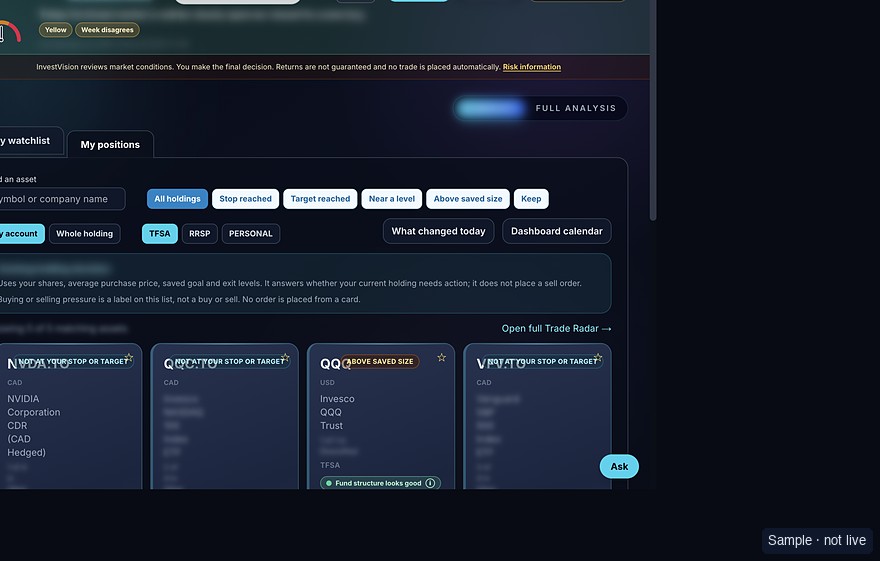
A simple habit: mark each holding with an account type — for example TFSA. That is for your own notebook, not a filing to the CRA.
Practical habits for tracking
- First see what you own: symbol, share count, currency (CAD or USD), and whether it sits in a TFSA.
- Before a new buy idea, write one sentence: why the idea, and what would invalidate it.
- If you have a mental stop or target, write it down as a plan note — not as an automatic sell order.
- Read market context and any entry checklist separately from account rules; the account label does not replace risk judgment.
Common beginner mistakes
Do not assume “it is in a TFSA, so there is no risk.” Account type does not remove price risk.
Do not run contribution or withdrawal rules from social-media memory — check CRA or a suitable professional.
Do not confuse cleaning up your notes with placing a trade. Understand what you hold first; then decide at your own broker if you choose.
If you want it on a practice desk
A tool like InvestVision can show the same rows with an account label (such as TFSA), currency, and a daily checklist so the decision is easier to practice. It does not place orders and it is not tax advice.
If you only want the concept, this page is enough. Always confirm account rules from an official source.